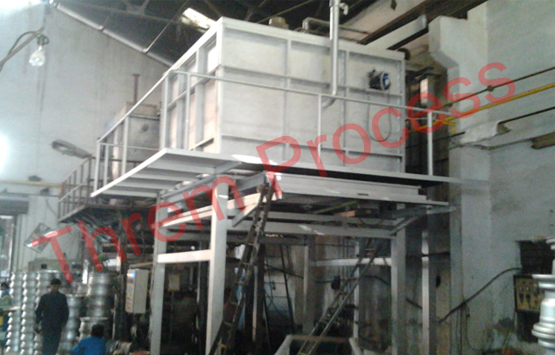
Therm process Engineering Pvt. Ltd. supplies complete solution annealing furnaces for stainless steel coils. Each furnace comes fully lined, with a dedicated charging machine, quenching mechanism and chimney. Solution annealing heats stainless steel to a high temperature to dissolve carbides into solution. The steel is then quenched rapidly, before they can re-form, and the transfer to quench must be fast. The Therm process design moves hot coils from hearth to quench tank within 40 to 50 seconds. These gas-fired furnaces handle 1 to 4 tonnes per batch and typically complete 6 to 7 charges per day. Share your coil size and daily tonnage for a proposal.
What Is Solution Annealing?
Solution annealing is a heat treatment mainly used for austenitic stainless steels. Cold working and earlier thermal exposure can leave chromium carbides at the grain boundaries. Those carbides reduce corrosion resistance and ductility.
Solution annealing heats the steel to a temperature at which these carbides dissolve back into the austenite, a "solid solution". The steel is held long enough for the whole section to reach that state, and is then quenched quickly, usually in water. Rapid cooling locks carbon in solution. Slow cooling through the sensitisation range would let carbides precipitate again, undoing the treatment.
This makes the transfer time from furnace to quench as important as the furnace temperature. A solution annealing furnace is therefore a system: the furnace, the handling equipment and the quench tank must all work together.
Therm process Solution Annealing Furnaces
Therm process supplies the complete system: the furnace with lining, a charging machine, the quenching mechanism and the chimney.
Charging machine: A dedicated charging machine with a fork-lift structure places stainless steel coils on the furnace hearth. Coils are loaded onto the charging machine by EOT crane. At the end of the heating cycle, the charging machine withdraws the coils and places them in the quench tank.
Quench timing: The system is designed to complete the quench operation within 40 to 50 seconds.
Cycle: A typical cycle is 1.5 hours heating and 1 hour soaking, allowing about 6-7 charges per day.
Combustion: The furnace uses Therm process gas burners. Each burner is set and calibrated for steady gas flow using Thermprocess's own limiting orifice valves. The gas station includes all relevant safety features.
Therm process describes the design as sturdy, energy efficient and well proven. It has a proven refractory lining pattern and a low-maintenance charging machine
Technical Specifications
| Parameter | Specification |
|---|---|
| Furnace Type | Batch solution annealing furnace with quench |
| Charge | Stainless steel coils |
| Mode of Heating | Gas fired (Therm process burners) |
| Capacity | 1 to 4 tonnes per batch |
| Typical Cycle | 1.5 hr heating + 1 hr soaking |
| Charges per Day | About 6-7 |
| Quench Transfer | Within 40-50 seconds |
| Loading | EOT crane to charging machine; fork-lift type charging machine to hearth |
| Burner Flow Setting | Therm process limiting orifice valve per burner |
| Gas Station | With relevant safety features |
| Scope of Supply | Lined furnace, charging machine, quenching mechanism, chimney |
| Operating Temperature | As per material specification |
Key Features
How the Solution Annealing Process Works
Applications
Industries Served
Benefits
Custom Solution Annealing Solutions
Share the following:
Why Choose Thermprocess?
Related Therm process Products
Frequently Asked Questions
Q1. What is a solution annealing furnace?
Q2. Why is quench time so important in solution annealing?
Q3. What capacity solution annealing furnaces does Therm process supply?
Q4. How long is a typical solution annealing cycle?
Q5. What does Therm process supply with the furnace?
Q6. What information is needed for a quotation?
Looking for a Solution Annealing Furnace Manufacturer in India?
Share your SS grade, coil size, batch weight and daily tonnage. Therm process will propose a complete solution annealing system with charging and quench.
Request a Quote