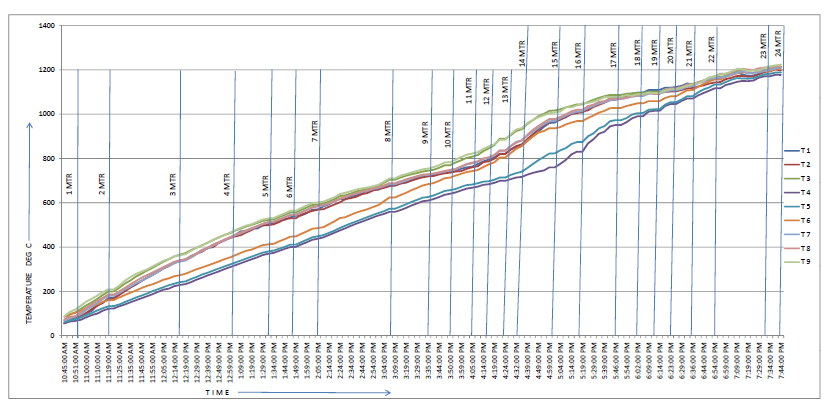
Most furnaces are controlled by the temperature of the furnace atmosphere, not by the temperature of the steel inside them. Furnace profiling closes that gap. Therm process Engineering Pvt. Ltd. attaches thermocouples directly to the charge, at different points across the section and at different locations in the load. It then records the actual temperature the charge experiences from charging to discharge. The resulting profile shows where the furnace heats well, where it doesn't, and how soaking time and zone temperatures can be corrected. Contact us to plan a profiling study.
What Is Furnace Profiling?
Furnace profiling is the process of recording and interpreting the temperature of the charge during actual production. In a reheating furnace the charge is billets; in a heat treatment furnace it may be components or coils.
Furnace thermocouples measure the temperature of the furnace gases or walls. That is useful, but it is not the same as the temperature of the steel. The core of a thick billet can lag the surface by a large margin. A furnace can therefore read "correct" while discharging under-heated steel, or it can burn extra fuel to overheat steel that was already at temperature.
In a profiling run, thermocouples are fixed to the charge at chosen points, such as surface and core, across the section and at different locations. The charge then travels through the furnace under normal production conditions, and temperature data is recorded continuously. The output is a time-temperature graph for the charge from entry to exit.
Therm process Furnace Profiling
Therm process applies its furnace design and combustion experience to interpret profiling results, not just record them. A profiling study typically answers these questions:
- Is the charge reaching target temperature at discharge, surface and core?
- How long does the charge actually spend in soaking?
- Which zones are under- or over-performing?
- Is the furnace setpoint higher than it needs to be?
- Where can the heating cycle be shortened or fuel reduced?
Findings can then feed into corrections: zone setpoints, soak time, burner adjustment or, where needed, combustion system upgrades.
Technical Specifications
| Parameter |
Specification |
| Service |
Temperature profiling of charge during actual production |
| Furnace Types |
Reheating furnaces (pusher, walking hearth) and heat treatment furnaces, as applicable |
| Measurement |
Thermocouples attached directly to the charge at different cross-sections and locations |
| Data |
Continuous temperature recording from charge to discharge |
| Output |
Temperature profile graph and interpretation |
| Recommendations |
Heating process, soaking time and furnace temperature corrections |
Advantages of Furnace Profiling
- Thermal analysis of the product See what the steel actually experiences.
- Quality control Confirm that every part of the charge reaches the required temperature.
- Improper heating zone detection Identify weak or overfired zones.
- Increased productivity Remove unnecessary soak time where the profile allows.
- Minimised fuel cost Avoid overheating and excess setpoints.
- Improved heating cycle and process Base changes on measured data.
How a Profiling Study Works
- Planning Agree the furnace, charge type, measurement points and production conditions.
- Instrumentation Attach thermocouples to a representative charge piece.
- Profiling run The instrumented charge passes through the furnace with normal production.
- Data recording Temperatures are logged continuously from charge to discharge.
- Analysis Compare the charge temperature curve with furnace setpoints and target values.
- Recommendations Propose corrections to zone temperatures, soaking time and heating practice.
Who Needs Furnace Profiling?
- Rolling mills with inconsistent billet temperature, cobbles or high fuel consumption.
- Forging plants checking through-heating of billets.
- Heat treatment shops needing documented evidence of process temperatures.
- Plants that have revamped a furnace and want to verify performance.
- Plants considering fuel conversion and needing a baseline.
Benefits
- Decisions based on measured charge temperature, not assumptions.
- Often reveals fuel savings without capital spend.
- Supports quality audits with recorded data.
- Provides a baseline for evaluating upgrades.
Why Choose Thermprocess?
- Furnace designers since 1997. The team understands why a furnace heats the way it does.
- Combustion system expertise to act on the findings.
- Reheating and heat treatment furnace experience across rolling mills, forging and engineering.
- ISO 9001 & ISO 14001 certified, as stated by the company.
Related Therm process Products
- Reheat Furnace
- Pusher Furnace
- Walking Hearth / Beam Furnace
- Industrial Burners
- Recuperator / Economizer
Frequently Asked Questions
Q1. What is furnace profiling?
Furnace profiling records the actual temperature of the charge, such as billets, during normal production. Thermocouples are attached directly to the charge, giving a temperature graph from charging to discharge.
Q2. Why isn't the furnace thermocouple reading enough?
Furnace thermocouples measure the furnace atmosphere or walls, not the steel. The billet core can lag well behind, so the furnace may read correctly while the steel is under-heated or overheated.
Q3. How can profiling reduce fuel cost?
By showing the actual charge temperature, profiling reveals overheating, excess soaking and poorly performing zones. Correcting these reduces fuel without affecting quality.
Q4. Which furnaces can be profiled?
Profiling is most commonly done on billet reheating furnaces. It can also be applied to heat treatment furnaces, where the charge temperature must be verified.
Q5. What happens after a profiling study?
Therm process analyses the data and recommends corrections to zone temperatures, soaking time and heating practice. Where needed, it can also recommend burner or heat recovery upgrades.
Want to Know What Your Charge Really Sees?
Share your furnace type, capacity, charge size and the problem you are trying to solve, whether that is fuel, quality or output. Therm process will plan a profiling study.
Request a Quote