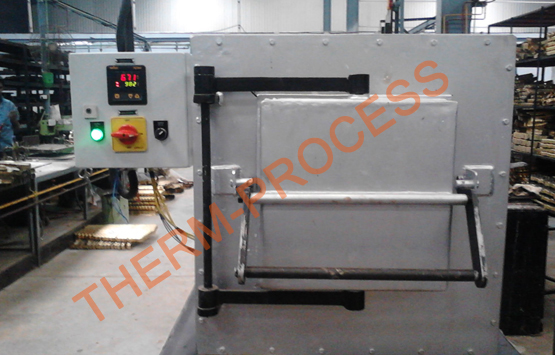
Therm process Engineering Pvt. Ltd. manufactures electrically heated box and muffle furnaces for small-batch heat treatment, tool-room work and material testing. In a muffle furnace, the workload sits inside a heated chamber and never touches a flame or combustion gases. The chamber walls radiate heat evenly onto the parts. Therm process offers standard ratings from 2 kW to 9 kW and builds custom chamber sizes on request. Both designs are available: heating elements wrapped around the muffle, or elements inside the chamber. Tell us your part size and process to get the right model.
What Is a Muffle Furnace?
A muffle furnace is a furnace with an enclosed, heated chamber called the muffle. The chamber walls are brought to temperature and radiate heat onto the material inside. The material has no contact with flame or products of combustion.
Historically, the muffle separated the work piece from fuel-fired flames. Today most muffle furnaces are electrically heated. This removes combustion entirely and makes temperature easier to control.
A box furnace is the front-loading, box-shaped form of this design. Parts are placed inside through a door, heated to a set temperature, held for the required time, and removed. It is a batch process suited to small components, samples, tools and short runs.
Muffle and box furnaces are used where temperature uniformity and a clean heating environment matter more than throughput. Typical examples are hardening a set of dies in a tool room, tempering small parts, or testing samples at a controlled temperature.
Therm process Box & Muffle Furnaces
Therm process manufactures electrically heated muffle furnaces in two established designs:
1.Heating elements wrapped over the muffle chamber The elements sit outside the muffle and heat it from the outside. This protects the elements from the workload and from any fumes the parts give off.
2.Heating elements inside the muffle chamber The elements face the workload directly for more direct radiant heating.
The right design depends on the parts, the process and maintenance preferences.
Because heating is electrical, there is no combustion in the process. This gives greater temperature uniformity inside the chamber and a cleaner working environment around the furnace.
Standard muffle furnaces are available in five sizes from 2 kW to 9 kW. Therm process also produces heating elements for muffle furnaces, which simplifies spares and replacement. Custom chamber sizes, ratings and controls can be engineered where standard models do not fit.
Technical Specifications
| Parameter |
Specification |
| Furnace Type |
Electrically heated box / muffle furnace (batch) |
| Heating Method |
Electric resistance heating elements |
| Element Arrangement |
Wrapped over muffle chamber, or inside muffle chamber |
| Maximum Temperature |
800-900°C (standard models) |
| Supply Voltage |
215 V (standard models) |
| Standard Sizes & Ratings |
4 x 4 x 9 - 2 kW, 5 x 5 x 10 - 3 kW, 6 x 6 x 12 - 4 kW, 9 x 9 x 12 - 6 kW, 9 x 9 x 18 - 9 kW |
| Approx. Metric Chamber Sizes |
~100 x 100 x 230 mm to ~230 x 230 x 460 mm |
| Furnace Weight |
Approx. 75-250 kg, depending on model |
| Atmosphere |
Air (no combustion products) |
| Loading |
Front door, manual loading |
| Temperature Control |
As per application |
| Customization |
Chamber size, rating and controls as per requirement |
Key Features
- No flame contact The workload is heated only by radiation from the chamber.
- Electric heating No fuel storage, burners or flue gases.
- Better temperature uniformity The heated muffle surrounds the charge.
- Two element layouts External wrapped or internal elements, to suit process and maintenance needs.
- Five standard ratings Compact 2 kW to 9 kW models cover most tool-room and small-batch needs.
- In-house heating elements Replacement elements are available from the manufacturer.
- Compact footprint Suits tool rooms, QC labs and small heat-treatment bays.
How a Muffle Furnace Works
- Loading Parts or samples are placed in the chamber through the front door, on the hearth or in a tray.
- Heating The elements heat the muffle walls, which radiate heat evenly onto the workload. The controller ramps the chamber to the setpoint.
- Soaking The chamber holds temperature for the time the process needs, so the parts reach uniform temperature.
- Cooling Depending on the process, parts are removed hot for quenching, or allowed to cool in the furnace or in air.
- Unloading and checking Parts are removed and, where needed, checked for hardness or other properties.
Applications of Box / Muffle Furnaces
- Hardening of small tools and dies Heating tool steel parts before quenching, within the furnace’s temperature range.
- Tempering Reheating hardened parts to a lower temperature to reduce brittleness and relieve stress.
- Annealing and stress relieving Softening small components or relieving machining and welding stresses.
- Preheating Bringing parts to temperature before welding, brazing or further processing.
- Material testing and QC Heating samples at controlled temperatures for laboratory and quality checks.
- Small-batch R&D work Trial heat treatments before scaling up to production furnaces.
Industries Using Muffle Furnaces
- Tool rooms and die shops Heat treatment of punches, dies, cutters and small tools.
- Engineering workshops Small-batch hardening, tempering and stress relieving.
- Automotive component suppliers Trial and QC heat treatment of small parts.
- Quality control and testing labs Controlled heating of samples.
- Educational and research institutions Metallurgy and materials testing.
Benefits of a Therm process Muffle Furnace
- Clean heating No soot, flame or combustion products reach the parts.
- Repeatable results Radiant heating from all sides gives more consistent batches.
- Simple installation Electric supply only; no fuel lines or chimney.
- Easy operation Front loading and straightforward temperature setting.
- Low running complexity Fewer systems to maintain than fuel-fired furnaces.
- Scalable Standard sizes, with custom builds available when parts are larger.
Custom Box / Muffle Furnace Solutions
If a standard model doesn't fit your parts, Therm process can engineer a box furnace around:
- Part size and chamber dimensions
- Batch weight
- Required temperature and soaking time
- Element arrangement (wrapped or internal)
- Power rating and supply voltage
- Door type and loading method
- Temperature controller and programming requirements
- Available floor or bench space
Why Choose Therm process?
- Mumbai-based manufacturer since 1997. Local support for customers across Maharashtra.
- In-house design and manufacturing of furnaces and heating elements.
- ISO 9001 & ISO 14001 certified, as stated by the company.
- Full heat treatment range. From compact muffle furnaces to bright annealing, bogie hearth and continuous furnaces, so customers can scale up with the same supplier.
- Quality checks on raw material and finished equipment before dispatch.
Related Therm process Products
- Bright Annealing Furnace
- Hardening Furnace
- Tempering Furnace
- Furnace for Normalizing / Annealing
- Electric Drying Oven
- Forging Furnace / Chamber Furnace
Frequently Asked Questions
Q1. What is a muffle furnace used for?
A muffle furnace is used to heat parts or samples in an enclosed chamber without flame contact. Typical uses include small-batch hardening, tempering, annealing, stress relieving, preheating and laboratory testing.
Q2. What is the difference between a box furnace and a muffle furnace?
A box furnace is a front-loading, box-shaped batch furnace. A muffle furnace is a box furnace in which the workload sits inside a heated muffle chamber, isolated from flame or heating elements. Electric models are often called either name.
Q3. What sizes of muffle furnace does Therm process offer?
Standard models range from 4"x4"x9"(2 kW) to 9"x9"x18"x(9 kW), with intermediate 3 kW, 4 kW and 6 kW sizes. Custom chamber sizes can be built on request.
Q4. What temperature can a Therm process muffle furnace reach?
Standard Therm process muffle furnaces are rated for a maximum of about 800-900°C. For higher-temperature processes, share your requirement so a suitable design can be evaluated.
Q5. Should I choose elements inside or outside the muffle?
Wrapped external elements protect the elements from the workload and any fumes. Internal elements give more direct radiant heating. The better option depends on your parts, process and maintenance preferences
Q6. Is an electric muffle furnace suitable for production heat treatment?
Muffle furnaces suit small batches, tool rooms and testing. For higher production volumes, a bogie hearth, bright annealing or continuous furnace is usually more economical.
Q7. What information is needed for a quotation?
Share the part dimensions, batch weight, process (hardening, tempering, annealing or testing), required temperature, available power supply and quantity required.
Looking for a Muffle Furnace Manufacturer in Mumbai?
Tell us what you need to heat treat and we will suggest a standard model or a custom build. Share the part size, batch weight, process, required temperature, power supply and your location. Therm process will recommend the right box or muffle furnace.
Request a Quote