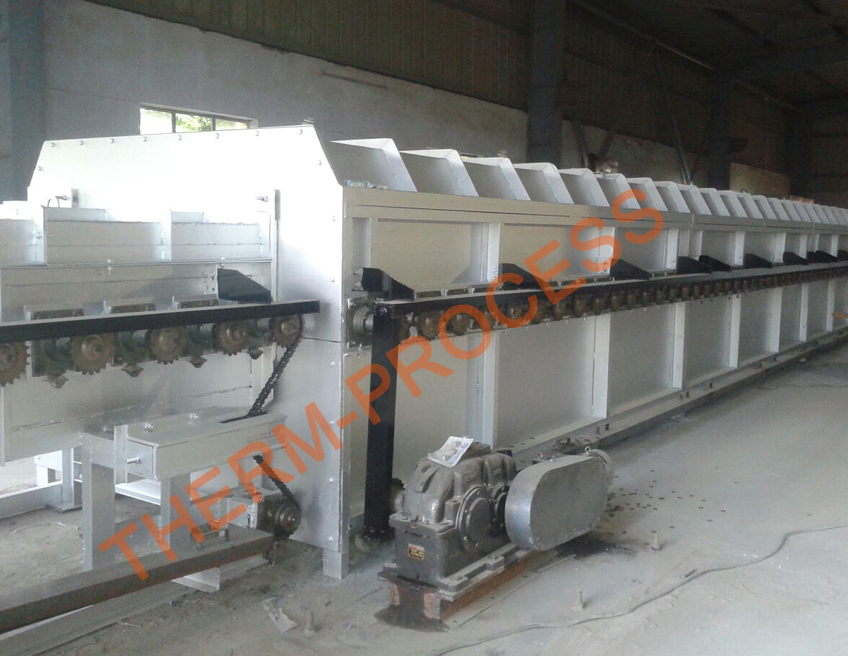
Therm process Engineering Pvt. Ltd. designs and manufactures tempering furnaces for hardened steel components and bars. Tempering reheats hardened steel to a controlled temperature below the critical range. This reduces brittleness and internal stress and sets the final balance of hardness and toughness. Therm process supplies batch tempering capability through its hardening and tempering (universal) and bright annealing furnaces. It also supplies continuous tempering through electrically heated roller hearth furnaces, with a reference unit running at 650-800°C and 750 kg/hr. Share your part or bar details for a recommendation.
What Is a Tempering Furnace?
A tempering furnace heats previously hardened steel to a sub-critical temperature, holds it for a set time, and allows it to cool. After quenching, steel has a hard but brittle martensitic structure with high residual stress. Tempering relieves that stress and trades a small amount of hardness for a large gain in toughness.
The tempering temperature is the main control lever. Lower temperatures keep more hardness, while higher temperatures give more toughness and ductility. Small deviations change the final properties, so tempering furnaces must hold temperature accurately and uniformly across the whole load.
Tempering can be done in batch furnaces for mixed components, or in continuous furnaces such as roller hearth lines for high volumes of bars or tubes, where every piece gets the same cycle.
Therm process Tempering Furnaces
Therm process offers tempering capability in three forms:
Continuous roller hearth tempering furnace. This is an electrically heated line for bars. The reference installation tempers martensitic stainless steel and low alloy steel bars of about 5-25 mm diameter and 4-5 m length. It runs at 750 kg/hr and an operating temperature of 650-800°C.
Hardening and tempering (universal) furnaces. These batch furnaces are used across engineering industries and for forging heat treatment. They are custom designed to the customer's components and specification.
Bright annealing furnaces. These are also commonly used for tempering automobile parts where a clean surface finish is needed. They are available electrically heated, LDO fired or gas fired, from 300 kg to 3 tons per charge.
Therm process selects the configuration according to part geometry, volume and surface finish requirement
Technical Specifications
| Parameter | Roller Hearth Tempering (Reference) | Batch Tempering |
|---|---|---|
| Operation | Continuous | Batch |
| Capacity | 750 kg/hr | As per application (bright annealing type: 300 kg-3 T/charge) |
| Charge | Martensitic SS and low alloy steel bars, ~5-25 mm dia x 4-5 m | Engineering components, automobile parts, forgings |
| Heating | Electric | Electric / LDO / gas, as per design |
| Operating Temperature | 650-800°C | As per process |
| Temperature Control | Zone-wise microprocessor control | Microprocessor-based, as per application |
| Customization | As per requirement | As per requirement |
Key Features
How Tempering Works
Applications
Industries Served
Benefits
Custom Tempering Furnace Solutions
Share the following:
Why Choose Thermprocess?
Related Therm process Products
Frequently Asked Questions
Q1. What is a tempering furnace used for?
Q2. What temperature does a tempering furnace operate at?
Q3. What is the difference between batch and continuous tempering?
Q4. Can tempering be done without scaling the parts?
Q5. What information is needed for a quotation?
Looking for a Tempering Furnace Manufacturer in India?
Share your material, hardness target, part size and throughput. Therm process will recommend a batch or continuous tempering solution.
Request a Quote