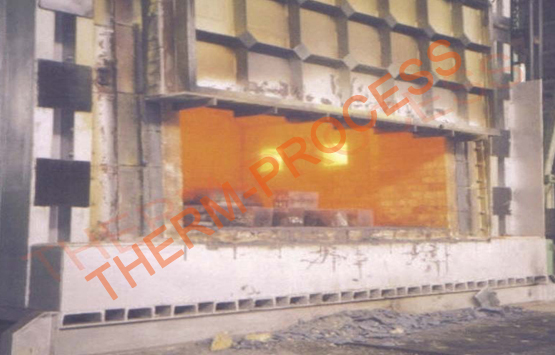
Therm process Engineering Pvt. Ltd. designs and manufactures chamber type forging furnaces for heating billets and ingots before forging. These batch furnaces operate at about 1200-1250°C, where steel is plastic enough to forge under a press or hammer. Heat reaches the charge mainly by radiation from the chamber and flame. Therm process builds forging furnaces for batch sizes from 250 kg up to 30 tonnes. Designs can include veneering insulation and in-house burners suited to the forge shop's fuel. Share your ingot or billet size and forging schedule to receive a furnace recommendation.
What Is a Forging Furnace?
A forging furnace heats metal to forging temperature so it can be shaped under compressive force. For carbon and alloy steels, this typically means bringing billets or ingots to around 1200-1250°C. The whole cross-section must be at a workable temperature, not just the surface.
A chamber furnace is the most common forging furnace in open-die and closed-die forge shops. It is a refractory-lined chamber with a door, fired by burners. The charge sits on the hearth, and heat is transferred largely by radiation from the hot walls, roof and flame.
The operating cycle has three parts: Heat-up time to bring the charge to temperature, soaking time to equalise the core, and forging time while pieces are drawn out and worked. Large forgings often need reheating between forging passes. Fuel consumption therefore depends heavily on charge type and the number of reheats.
Good forging furnace design balances fast heat-up against uniform soaking. It also needs to minimise scale, and to keep the chamber at temperature efficiently through long daily operation.
Therm process Forging Furnaces
Therm process designs forging chamber furnaces around the forge shop's charge weight, piece dimensions and shift pattern. Its forging furnaces typically operate 16 to 18 hours a day, and batch capacities range from 250 kg to 30 tonnes.
The furnaces use an open fireplace design, where most heat reaches the charge by radiation. Burners are designed and manufactured in-house by Therm process for oil, gaseous or dual-fuel firing.
For insulation, Therm process offers veneering insulation technology. A ceramic fibre veneer is applied to the refractory hot face. This lowers the heat stored in the lining and the heat lost through it. The results are faster start-up heating, longer refractory life and better production rates, at modest capital cost. It can also be applied when upgrading an existing furnace.
Where the charge specification and volume justify it, Therm process may recommend a pusher furnace for forging instead of a batch chamber furnace. Twin chamber and box-type forging furnaces are also part of its range.
Technical Specifications
| Parameter |
Specification |
| Furnace Type |
Batch chamber furnace (single / twin chamber, box type) |
| Operating Temperature |
Approx. 1200 °C to 1250 °C |
| Batch Capacity |
250 kg to 30 tonnes per batch |
| Charge |
Billets and ingots for forging |
| Heat Transfer |
Predominantly radiation (open fireplace system) |
| Heating Method |
Burner-fired (in-house Therm process burners) |
| Fuel |
As per site availability - oil, gas or dual fuel |
| Typical Operation |
16-18 hours per day |
| Operating Cycle |
Heat-up - soaking - forging (with reheats as required) |
| Insulation |
Refractory with veneering insulation option |
| Loading |
Manual / manipulator / charging machine, as per application |
| Temperature Control |
Automatic / manual, as per application |
| Customization |
Chamber size, door design, number of chambers, firing as per requirement |
Key Features
- Forging-temperature capability. Designed to hold 1200-1250°C through long daily operation.
- Wide batch range. From 250 kg to 30 tonnes per batch.
- Radiant heat transfer. Open fireplace construction heats the charge evenly across its exposed surfaces.
- Veneering insulation option. Reduces lining heat storage for quicker start-up and longer refractory life.
- In-house burners. Combustion system matched to chamber geometry and fuel.
- Single, twin chamber or box configurations. Suited to different forging flows.
- Retrofit potential. Insulation upgrades can be applied to existing forging furnaces.
How a Forging Chamber Furnace Works
- Loading Billets or ingots are placed on the hearth, by hand, manipulator or charging machine, depending on weight.
- Heat-up Burners fire at high rate to raise the charge towards forging temperature. Heat reaches the charge mainly by radiation.
- Soaking Firing is controlled to hold temperature until the core catches up with the surface. Soaking time grows with section size.
- Forging Heated pieces are withdrawn and forged. The furnace holds temperature for the next piece.
- Reheating Large forgings that cool below workable temperature return to the furnace between passes.
- Cycle close At the end of the shift the furnace is idled or shut down. Low-heat-storage linings help the next start-up.
Applications of Forging Furnaces
- Open-die forging Heating large ingots and blooms for shafts, rings, discs and blocks.
- Closed-die forging Heating billets for die forgings where temperature consistency affects die fill and die life.
- Reheating between passes Returning partly forged workpieces to temperature for further working.
- Preheating billets and ingots Bringing stock to temperature ahead of pressing, hammering or ring rolling.
Industries Using Forging Furnaces
- Forging industry
. Open-die and closed-die forge shops, from small hammer shops to heavy press shops.
- Automotive
. Suppliers producing crankshafts, axles, gears and connecting components.
- Heavy engineering
. Large shafts, rolls, flanges and pressure-part forgings.
- Steel plants
. Heating ingots and blooms for forging and cogging operations.
Benefits of a Therm process Forging Furnace
- Consistent forging temperature, which reduces die wear and forging defects.
- Faster start-up, with low-heat-storage veneering insulation.
- Longer refractory life, which reduces relining downtime.
- Better fuel use, from matched burners and lining design.
- Right-sized capacity for the forge shop's batch and shift pattern.
- Upgrade path for existing furnaces through insulation retrofits.
Custom Forging Furnace Solutions
Therm process configures each forging furnace around:
- Material grade (carbon steel, alloy steel, stainless steel)
- Ingot or billet dimensions and weight
- Batch weight and pieces per batch
- Forging temperature and soaking requirement
- Number of reheats per forging
- Daily operating hours
- Fuel available at site
- Single, twin chamber or box configuration
- Door type and loading method (manual, manipulator, charging machine)
- Insulation type, including veneering
- Temperature control and automation level
- Floor space and forge layout
For high-volume billet forging, Therm process can also evaluate a continuous pusher furnace.
Why Choose Therm process?
- Established 1997 in Mumbai, designing and manufacturing industrial furnaces and burners.
- In-house furnace and burner design, built to the customer's specification.
- ISO 9001 & ISO 14001 certified, as stated by the company.
- Forging and reheating expertise across chamber, pusher and walking hearth furnaces.
- Complete scope including combustion equipment, recuperators, erection and commissioning.
Related Therm process Products
- Pusher Furnace (for continuous forging)
- Bogie Hearth Furnace (heavy forgings heat treatment)
- Box / Muffle Furnace
- Furnace for Normalizing / Annealing
- Industrial Burners
- Recuperator / Economizer
Frequently Asked Questions
Q1. What is a forging furnace used for?
A forging furnace heats billets and ingots to forging temperature, typically 1200-1250°C for steel. The metal can then be shaped by a hammer, press or ring rolling machine. It is also used to reheat partly forged work pieces between passes.
Q2.What temperature does a forging furnace operate at?
Therm process forging chamber furnaces operate at around 1200 to 1250°C. The exact set point depends on the material grade and forging practice.
Q3. What batch sizes are available?
Therm process forging furnaces are designed for batch capacities from 250 kg to 30 tonnes. The chamber is sized to your largest piece and typical batch weight.
Q4. What is veneering insulation in a forging furnace?
Veneering is a layer of ceramic fibre applied to the hot face of the refractory lining. It reduces the heat absorbed and lost by the lining. This shortens start-up time, extends refractory life and improves furnace productivity.
Q5. What affects fuel consumption in a forging furnace?
Fuel consumption depends mainly on charge type and size, the number of reheats, daily operating hours, lining insulation and burner efficiency. Reducing reheats and lining heat loss typically has the biggest impact.
Q6. Should I use a chamber furnace or a pusher furnace for forging?
Chamber furnaces suit varied piece sizes, heavy ingots and batch forging. For high volumes of uniform billets, a continuous pusher furnace can be more productive. Therm process recommends the type after reviewing your charge and output.
Q7. What information is needed for a forging furnace quotation?
Share material grade, piece dimensions and weight, batch size, forging temperature, reheats, operating hours, fuel, and loading method. Include your available space, and existing furnace details if replacing or upgrading.
Looking for a Forging Furnace Manufacturer in India?
Whether you run a hammer shop or a heavy press line, Therm process can recommend a forging furnace to suit your work. Share your material, piece size and weight, batch capacity, forging temperature, daily operating hours, fuel and plant location. We will suggest a chamber, twin chamber or continuous configuration.
Request a Quote