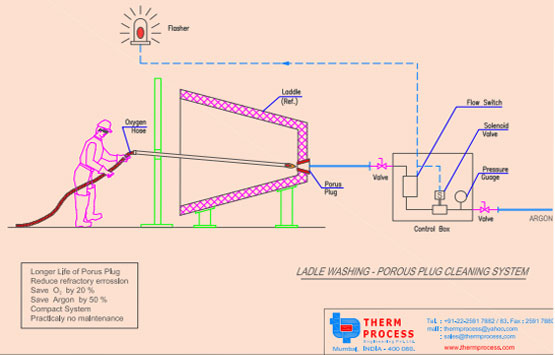
Therm process Engineering Pvt. Ltd. offers an oxygen washing control system for cleaning ladle porous plugs. It is designed to save costly oxygen, argon and nitrogen. In most melt shops, the operator cleaning the porous plug with oxygen cannot see whether the plug has opened. The argon or nitrogen purge is on the other side of the ladle. Both gases are left on longer than needed, wasting gas and eroding refractory. The Therm process system detects when the plug is clear and signals the oxygen operator to stop. It also shuts off argon automatically.
What Is Porous Plug Cleaning?
A steel ladle has a porous plug set in its bottom refractory. Inert gas, argon or nitrogen, is blown through the plug to stir the liquid steel. This homogenises temperature and composition and helps float out inclusions
After a heat, residual steel and slag can freeze in and over the plug, blocking gas flow. Before the ladle is reused, the plug is cleaned. Typically an operator applies an oxygen lance from inside the ladle to burn out the blockage, while argon or nitrogen is purged through the plug from below to check whether it has opened.
The Problem with Conventional Cleaning
- The two operations are on opposite sides of the ladle The oxygen washing operator cannot see the argon or nitrogen purge.
- The oxygen operator doesn't know when the plug is clean so the oxygen flame stays on. This damages costly refractory around the plug and wastes oxygen.
- The purge side doesn't know either so argon supply is left on unnecessarily.
- Stopping is based on assumption Oxygen and argon are usually stopped by guesswork and approximation.
How the Therm process System Works
The Therm process system adds a control box to the existing inert gas line:
- Connection The existing argon or nitrogen line is connected to the control box inlet. The outlet connects to the ladle porous plug point.
- Monitoring A flow switch in the control box monitors gas flow to the plug.
- Detection While the plug is blocked, there is no flow. When the plug is cleaned, argon or nitrogen flow starts.
- Signal Flow triggers a flasher signal to the oxygen washing operator to stop.
- Automatic shut-off The same signal closes an argon solenoid valve, stopping inert gas automatically.
- Regulation Valves in the control box regulate argon or nitrogen flow.
Technical Specifications
| Component |
Function |
| Control box |
Houses flow control and switching components |
| Regulating valves |
Regulate argon / nitrogen flow |
| Flow switch |
Detects gas flow once the plug is clear |
| Argon solenoid valve |
Stops inert gas automatically on signal |
| Flasher signal |
Tells the oxygen washing operator to stop |
| Connections |
Existing Ar/N₂ line to inlet; outlet to ladle porous plug point |
Advantages
- Reduced oxygen consumption during plug washing.
- Reduced argon or nitrogen consumption.
- Unnecessary refractory erosion eliminated, as the oxygen lance stops once the plug is clear.
- Operator friendly, with a clear visual signal replacing guesswork.
- Retrofit to existing ladle gas lines.
Who Needs It?
- •Steel melt shops with ladle argon or nitrogen stirring.
- Ladle furnace / secondary refining units.
- Plants looking to cut industrial gas costs and extend ladle refractory life.
Why Choose Thermprocess?
- Since 1997, Mumbai.
- Steel plant equipment experience, including reheating furnaces, delta pre heaters and ladle preheaters.
- ISO 9001 & ISO 14001 certified, as stated by the company
Related Therm process Products
- Delta Pre Heater
- Ladle Preheater
- Accessories
- Limiting Orifice Valve
Frequently Asked Questions
Q1. What is a ladle porous plug?
It is a gas-permeable refractory element in the ladle bottom. Argon or nitrogen is blown through it to stir liquid steel.
Q2. Why do porous plugs need cleaning?
Residual steel and slag can freeze in or over the plug after a heat and block gas flow. The plug is usually cleaned with oxygen washing before the ladle is reused.
Q3. What problem does the porous plug cleaning system solve?
The oxygen operator and the purge operator are on opposite sides of the ladle and can't tell when the plug is clean. Oxygen and argon are therefore left on too long, wasting gas and eroding refractory.
Q4. How does the system know the plug is clean?
A flow switch in the control box detects when argon or nitrogen starts flowing through the plug. This triggers a flasher signal to the oxygen operator and closes the argon solenoid valve.
Q5. Can it be fitted to existing ladles?
Yes. The existing argon or nitrogen line connects to the control box inlet, and the outlet connects to the ladle porous plug point.
Cut Gas Waste in Porous Plug Cleaning
Share your ladle size, number of ladles, gas used for purging and current cleaning practice. Therm process will propose a control system for your melt shop.
Request a Quote