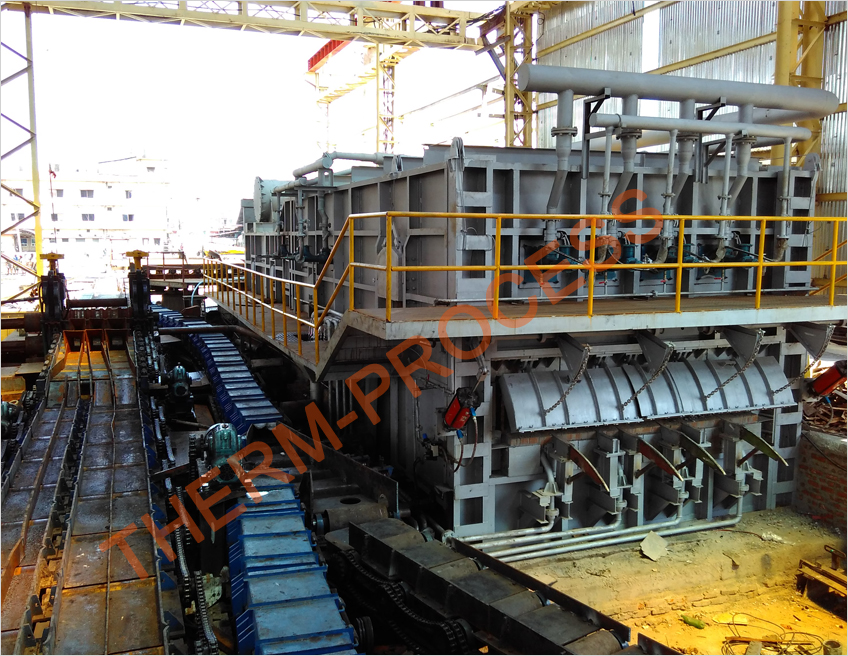
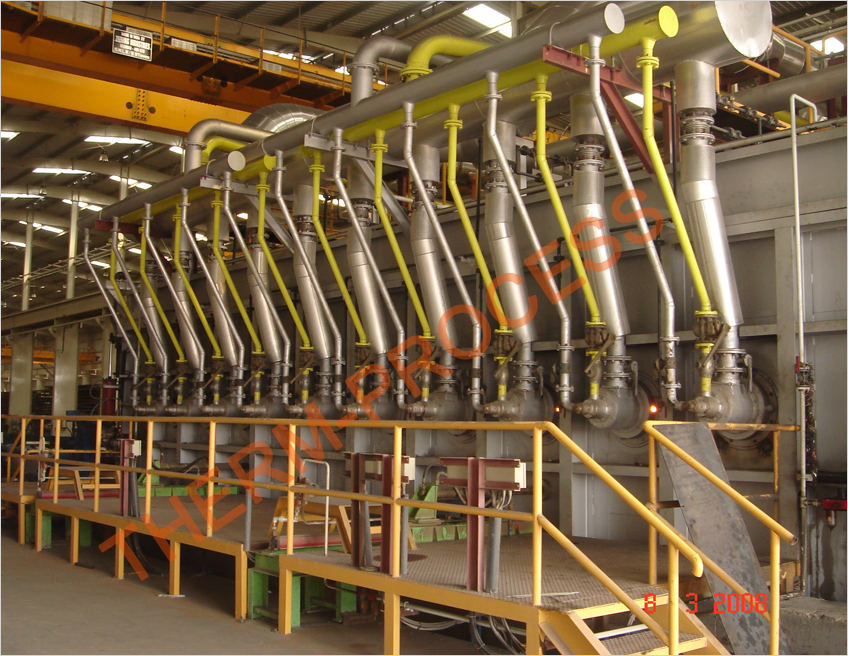
Therm process Engineering Pvt. Ltd. designs and manufactures pusher type reheating furnaces for steel rolling and re-rolling mills. A pusher furnace heats billets and ingots continuously to rolling temperature. Charge enters at one end and is pushed along water-cooled skids through the preheating, heating and soaking zones. Therm process builds top-fired and top & bottom fired configurations for mild steel, carbon steel, stainless steel and special alloy steel billets. Firing options cover furnace oil, producer gas, coal gas, natural gas and dual fuel. Share your billet size, output target and fuel to receive a furnace proposal engineered around your mill.
What Is a Pusher Furnace?
A pusher furnace is a continuous reheating furnace. Billets, blooms or ingots are loaded side by side at the charging end. A charging pusher advances the entire row by one billet width each time a new piece enters. Heated material leaves at the discharge end, usually through a side or end discharge door, and moves straight to the rolling stand.
Inside the furnace, the charge passes through temperature zones in sequence. The preheating zone uses the flue gases leaving the furnace. The heating zone raises the billet to near rolling temperature. The soaking zone equalises temperature between the surface and the core.
Uniform billet temperature matters because it drives rolling-mill output. An under-heated core increases roll load and can crack stock. Overheating increases scale loss and wastes fuel. A well-designed pusher furnace delivers billets at a consistent temperature at a steady rate matched to mill speed. That makes it the most widely used reheating furnace type in Indian rolling and re-rolling mills.
Therm process Pusher Furnace Solutions
Therm process designs its pusher furnaces in-house. Each furnace is sized around the billet cross-section, billet length, hourly output and available fuel.
Two firing configurations are offered:
-
Top-fired pusher furnace. Burners fire from above the charge. This suits smaller billet cross-sections where heat penetration from one side is adequate.
-
Top & bottom fired pusher furnace. Burners fire above and below the charge. Billets travel on water-cooled skids, so both faces receive heat. This configuration is used for larger cross-sections, where uniform temperature through the billet is harder to achieve.
Therm process also manufactures the combustion system and auxiliaries that surround the furnace. These include industrial burners, recuperators for waste heat recovery, combustion blowers, heating and pumping units for fuel oil, and charging pushers with electro-mechanical or hydraulic drives. Discharge ejectors and flue dampers are also available. Temperature control can be automatic or manual, with microprocessor-based process controls available.
The company has supplied, erected and commissioned reheating furnaces for customers in India and abroad.
Technical Specifications
| Parameter |
Specification |
| Furnace Type |
Continuous pusher type reheating furnace (top-fired / top & bottom fired) |
| Standard Output |
5 TPH to 75 TPH (top & bottom fired designs up to 100 TPH as per Therm process reheat furnace data) |
| Charge |
Billets / ingots - MS, CS, SS and special alloy steels |
| Raw Material Size |
100 x 100 mm to 160 x 160 mm (larger sections in top & bottom fired design) |
| Billet Length |
1.5 m to 12 m |
| Fuel |
Furnace oil / producer gas / coal gas / natural gas / LPG / dual fuel |
| Charging |
Cold charging or hot charging |
| Charge Movement |
Charging pusher (electro-mechanical or hydraulic drive) along skids |
| Discharge |
Side or end discharge, as per mill layout |
| Temperature Control |
Automatic / manual |
| Heat Recovery |
Recuperator, as per design |
| Customization |
Zones, hearth width, firing layout and auxiliaries as per application |
Key Features
- Continuous operation matched to mill speed. Output is sized to the rolling mill's hourly requirement.
- Top & bottom firing option. Water-cooled skids expose both faces of the billet to heat for larger sections.
- Multi-fuel capability. Burners can be configured for oil, gaseous fuels or dual fuel. This helps plants that switch fuels based on cost or availability.
- In-house combustion equipment. Burners, recuperators and blowers are designed by the same team that designs the furnace.
-
Waste heat recovery. Recuperators preheat combustion air using flue gas heat.
-
Lower installation and maintenance cost. Therm process notes that pusher furnaces cost less to install and maintain than moving hearth furnaces.
- Wide charge range. One furnace can accept billet lengths from 1.5 m to 12 m within the design envelope.
How a Pusher Reheating Furnace Works
- Charging: A cold or hot billet is placed at the charging end. The charging pusher advances the entire row of billets by one billet width.
- Preheating: The billet enters the unfired or lightly fired zone. Here, outgoing flue gases raise its temperature and recover heat that would otherwise be lost.
- Heating: Burners in the main heating zone bring the billet close to rolling temperature. In top & bottom fired furnaces, lower burners heat the underside through the skid space.
- Soaking: The billet passes through the soaking zone, where firing is controlled. This lets the core catch up with the surface and reduces temperature difference across the section.
- Discharge: The hot billet is ejected at the discharge door and conveyed to the roughing stand.
- Monitoring: Zone temperatures and fuel-air ratios are monitored throughout, either automatically or by the operator. This keeps discharge temperature consistent from billet to billet.
Applications of Pusher Furnaces
- Billet reheating for bar and rebar rolling. This is the main application: TMT bars, rounds, squares and flats from MS and CS billets.
- Reheating for re-rolling mills. Reheating billets or ingots for sections, angles, channels and flats.
- Alloy and stainless steel reheating. Reheating SS and special alloy steel billets, where controlled heating rates and uniform soaking are important.
- Reheating for forging. For suitable charge specifications, a pusher furnace can feed a continuous forging line. It is an alternative to batch chamber furnaces when volumes are high.
- Hot charging from a continuous caster. Accepting hot billets directly from a caster to reduce fuel demand, where plant layout allows.
Industries Using Pusher Furnaces
- Steel rolling mills Continuous billet reheating ahead of bar, rod and section mills.
- Re-rolling mills Small and mid-sized mills reheating purchased billets or ingots.
- Integrated steel plants Reheating furnaces fed from in-house caster lines.
- Forging industry High-volume reheating of billets ahead of forging presses and hammers.
- Alloy and stainless steel producers Reheating special steels that need controlled thermal profiles.
Benefits of a Therm process Pusher Furnace
- Predictable output Continuous charging gives a steady billet supply matched to rolling speed.
- Consistent discharge temperature Zoned firing and soaking reduce temperature variation that causes rolling defects.
- Lower fuel cost per tonne Preheating zones and recuperators recover flue-gas heat.
- Fuel flexibility Multi-fuel and dual-fuel burner options let plants adapt to fuel availability.
- Simpler mechanism Compared with moving hearth designs, fewer moving parts sit inside the hot zone.
- Single-source responsibility The furnace, burners and recuperator come from one engineering team.
Custom Pusher Furnace Solutions
No two rolling mills run the same billet mix. Therm process sizes each pusher furnace around:
-
Billet cross-section and length
-
Steel grade (MS, CS, SS, alloy)
-
Required output in TPH
-
Discharge temperature and rolling practice
-
Cold or hot charging
-
Available fuel and fuel cost
-
Top-fired or top & bottom fired configuration
-
Side or end discharge
-
Charging pusher drive (electro-mechanical or hydraulic)
-
Recuperator and heat recovery requirement
-
Available plant space and existing mill layout
-
Level of automation and instrumentation
For existing mills, Therm process can also assess furnace conversion, capacity enhancement or fuel changeover.
Why Choose Therm process?
- Established in 1997 Mumbai-based furnace and burner manufacturer with more than two decades in thermal process equipment.
- In-house design Furnaces, burners and recuperators are designed in-house and built to the customer's specification.
- Combustion specialists The company manufactures gas, oil and dual-fuel burners, radiant tube burners, recuperators and fuel handling units.
- ISO 9001 & ISO 14001 certified as stated by the company.
- Project execution Therm process designs, supplies, erects and commissions reheating furnaces for customers in India and overseas.
- Rolling-mill focus Its furnace and burner range serves steel plants, rolling mills and the automobile and aluminium industries.
Related Therm process Products
- Reheat Furnace.
- Walking Hearth / Beam Furnace.
- Forging Furnace / Chamber Furnace.
- Recuperator / Economizer.
- Industrial Burners.
- Furnace Accessories - Charging Pusher, Discharge Ejector, Heating Pumping Unit.
Frequently Asked Questions
Q1. What is a pusher furnace used for?
A pusher furnace is used to reheat steel billets and ingots continuously to rolling or forging temperature. It is the standard reheating furnace in rolling and re-rolling mills that produce bars, rods, sections and TMT rebar
Q2.What is the difference between a top-fired and a top & bottom fired pusher furnace?
A top-fired furnace heats the billet from above only and suits smaller cross-sections. A top & bottom fired furnace moves billets on water-cooled skids, with burners below the charge as well. This heats both faces and gives better through-section uniformity for larger billets.
Q3. What capacity pusher furnaces does Therm process manufacture
Therm process lists a standard output range of 5 TPH to 75 TPH for pusher furnaces. Top & bottom fired reheat designs are listed up to 100 TPH. The final rating depends on billet size, steel grade and discharge temperature.
Q4. What fuels can a pusher reheating furnace use?
Therm process pusher furnaces can be fired with furnace oil, producer gas, coal gas, natural gas, LPG or dual fuel. The burner system is selected according to fuel availability, cost and the plant's existing fuel infrastructure.
Q5. What billet sizes can a pusher furnace handle?
Standard designs cover billets from 100 x 100 mm to 160 x 160 mm and 1.5 m to 12 m long. Larger cross-sections are handled with top & bottom firing. Share your exact billet mix so the hearth and firing can be sized correctly.
Q6. Is a pusher furnace or a walking hearth furnace better for my mill?
Pusher furnaces have lower installation and maintenance cost and suit most MS and CS billet reheating. Walking hearth furnaces avoid skid marks and allow the furnace to be emptied. They are often preferred for alloy steel and larger sections. The right choice depends on grade, section and output.
Q7. Does Therm process provide erection and commissioning?
Yes. Therm process designs, supplies, erects and commissions reheating furnaces, including burners, recuperators and auxiliary equipment.
Q8. What information is required for a pusher furnace quotation?
Provide billet size and length, steel grade, required output in TPH, discharge temperature, cold or hot charging, available fuel, discharge arrangement and plant layout. Existing furnace details help if you are planning a replacement or upgrade.
Looking for a Pusher Furnace Manufacturer in India?
Tell us about your rolling mill and we will recommend a pusher furnace configuration to suit it. Share your billet size and length, steel grade, target output in TPH, discharge temperature, fuel, and whether charging will be hot or cold. Include your plant location and existing layout. Therm process engineers will review the details and propose a furnace design.
Request a Quote